A GIFT City institute, set up in partnership with





~24 Weeks

GIFT IFI Certificate
Artificial Intelligence and Machine Learning for FinTech is a career-oriented certificate program that helps learners understand how modern financial institutions use data, models, and intelligent systems to make decisions, manage risk, detect fraud, personalize services, and automate market-facing processes. The program brings together four complementary areas: financial data analytics and visualization, machine learning for decision systems, AI in risk and fraud, and quantitative modeling for trading and markets. This combination is timely because financial services firms are scaling AI across front-, middle-, and back-office functions, while regulators and industry bodies are also paying closer attention to explainability, governance, resilience, and concentration risk.
The certificate is designed to build both conceptual depth and applied capability. Learners do not just study algorithms in isolation; they learn how financial data is structured, how models are operationalized in real institutions, how AI supports underwriting and surveillance, and how quantitative methods are used in capital markets. This makes the program especially relevant in a period when banks and fintechs are trying to move from experimentation to measurable value creation with AI. McKinsey notes that AI in banking is moving beyond automation toward stronger decision quality and enterprise rewiring, while the World Economic Forum highlights AI as a major force shaping the future of fintech and financial services.
In academic terms, the program sits at the intersection of finance, statistics, computer science, economics, risk, and digital business. In professional terms, it prepares learners to speak the language of analysts, product teams, risk managers, quants, model validators, and fintech builders at the same time. It is therefore well suited to institutions that want a certificate that is both rigorous and market-relevant. Recent industry surveys and policy work suggest AI is already being used in areas such as revenue generation, cost reduction, fraud detection, risk management, market intelligence, and client servicing, even as concerns around cyber risk, model explainability, and market concentration continue to grow.
This certificate is ideal for students in finance, economics, business, statistics, mathematics, computer science, engineering, data science, and information systems who want to enter the financial services industry with a stronger applied understanding of AI and machine learning. It is particularly valuable for learners who want to bridge traditional finance education with emerging skills in analytics, modeling, automation, and digital decision-making. As fintech continues to prioritize AI, open finance, and data-driven product design, these blended skills are becoming more valuable in the market.
It is equally suitable for working professionals in banking, NBFCs, insurance, capital markets, payments, consulting, internal audit, risk, fraud operations, product management, and technology teams who want to upgrade their capabilities. Many professionals understand either finance or technology; this certificate is for those who want to connect the two in a practical way. The current direction of the industry suggests strong demand for people who can understand business use cases, work with data, interpret model outputs, and appreciate governance and risk constraints.
It is also a strong fit for career switchers and entrepreneurs who want to move into fintech, regtech, wealthtech, insurtech, or AI-enabled financial services. Because the program covers both analytical foundations and applied use cases, it can help learners reposition themselves for roles that are more strategic, technical, and innovation-oriented than traditional entry-level finance roles alone.
This certificate can support pathways into roles such as:
These pathways are increasingly relevant because financial institutions are using AI across customer intelligence, operational efficiency, fraud monitoring, market analysis, and risk management, while also needing people who can manage implementation responsibly. In other words, the market is not only looking for coders or finance specialists in isolation; it is increasingly valuing professionals who can operate at the intersection of financial judgment, data literacy, modeling, and governance.
This course introduces learners to the foundations of working with financial data: collecting it, cleaning it, structuring it, analyzing it, and presenting it in decision-useful ways. Students engage with transactional data, customer data, market data, portfolio data, and operating metrics, while learning how financial context shapes the interpretation of numbers. The emphasis is on turning raw data into insight rather than merely producing charts.
A major focus of the course is visualization for managerial and analytical decision-making. Students learn how dashboards, trend analysis, cohort views, performance summaries, anomaly displays, and risk visualizations can improve clarity for bankers, fintech managers, investors, and regulators. In financial services, good visualization is not cosmetic; it is often central to monitoring performance, spotting emerging issues, and communicating decisions quickly and credibly.
The course also builds a bridge to the later parts of the certificate by helping students understand data quality, feature selection, reporting logic, and the difference between descriptive, diagnostic, and predictive analytics. It is especially useful for learners who want to begin with practical analytical fluency before moving into more advanced machine learning, fraud detection, and quantitative modeling.
This course explores how machine learning can support financial decisions such as credit approval, customer segmentation, pricing, personalization, underwriting support, portfolio screening, and operational triage. Students study supervised and unsupervised learning in the context of real financial problems, with attention to accuracy, bias, explainability, and deployment. The course frames machine learning as a decision-support capability rather than a purely technical exercise.
A second core theme is the design of financial decision systems. Learners examine how models fit into broader workflows involving data pipelines, human review, exception handling, compliance constraints, and ongoing monitoring. This matters because financial institutions do not use models in a vacuum; they use them inside regulated processes where decisions can affect customers, balance sheets, and institutional reputation.
By the end of the course, students should understand not only what common machine learning methods do, but when they should and should not be used in finance. They begin to appreciate trade-offs between model performance and interpretability, and between speed of deployment and robustness. That makes the course valuable for future analysts, product managers, risk teams, and founders building AI-enabled financial products.
This course focuses on one of the most important uses of AI in finance: identifying, measuring, and responding to risk. Students learn how AI and machine learning can support credit risk analysis, transaction monitoring, anomaly detection, anti-fraud surveillance, early warning systems, and suspicious behavior identification. The course shows that the value of AI in risk lies not only in prediction, but also in prioritization, detection speed, and pattern recognition across large, messy datasets.
The course also highlights the special challenges of financial risk and fraud settings. Fraud is adaptive, data can be imbalanced, false positives are costly, and decisions often need to be made in near real time. Similarly, risk models may face regulatory expectations around documentation, validation, fairness, and explainability. Students therefore study both modeling techniques and the operational environment in which those models must function.
A major contribution of this course is that it teaches learners to see fraud and risk as dynamic systems rather than static categories. Threats evolve, customer behavior changes, and controls must be updated continuously. As financial institutions adopt more AI, they need professionals who can combine statistical reasoning, business judgment, governance awareness, and investigative thinking. This course is designed to develop exactly that mindset.
This course introduces students to the logic of model-driven decision-making in financial markets. It covers the foundations of quantitative financial modeling, including return analysis, volatility, factor thinking, signal generation, backtesting, and the use of algorithms to support trading and portfolio decisions. The objective is not only to teach technical techniques, but to help learners understand how quantitative models are built, tested, and interpreted in market settings.
Students also examine the architecture of algorithmic trading systems: data feeds, strategy logic, execution rules, transaction costs, slippage, latency, performance measurement, and risk controls. The course emphasizes that profitable quantitative ideas are only one part of the challenge; implementation discipline and robust evaluation are just as important. This helps learners separate theoretical models from deployable systems.
The broader goal of the course is to give students a structured introduction to modern quant thinking without losing sight of market realism. Learners come away with a better understanding of how statistics, optimization, and machine learning can inform trading and investment decisions, while also recognizing the risks of overfitting, regime shifts, and model fragility. This makes the course especially useful for those interested in capital markets, asset management, research, and trading technology.
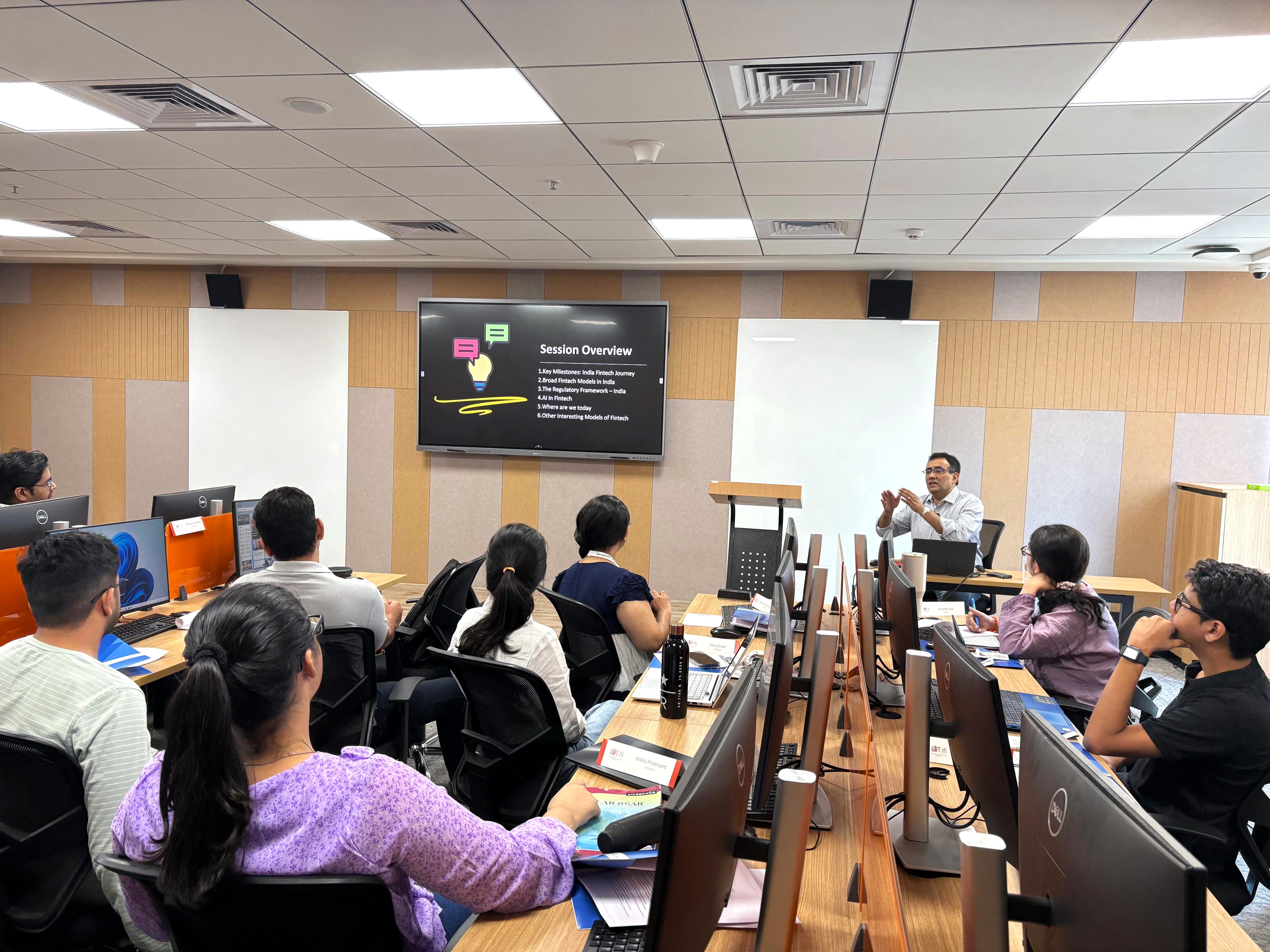
The programme is delivered in hybrid mode.
Minimum qualification: Undergraduate degree & Certificate in Fintech Foundations.
Note: Students who are in the final year of an undergraduate programme are eligible to apply.
For more details - please contact us +91 8511018177
|
|
|
|

Ahmedabad University
PhD, IIT Kharagpur

Blockverse
MBA, MDI Gurgaon

Great Lakes Institute of Management
PhD, IGIDR

Glomopay
LLM, Georgetown Law

IIT Gandhinagar
PhD, California Institute of Technology

Ahmedabad University
PhD, IIM Ahmedabad

IIT Gandhingar
PhD, Columbia University
Ahmedabad University

Multipl
MTech, IIIT Bangalore

IIT Gandhinagar
PhD, University of Göttingen

IIM Bangalore
PhD, London School of Economics and Political Science

Ahmedabad University
MBA from Maharaja Sayajirao University of Baroda

TCS
MSc, G. B. Pant University of Agriculture and Technology

Ahmedabad University
PhD, Golden Gate University